
In today’s ever-evolving industry, understanding the importance of warehouse racking system is crucial for staying competitive and making informed decisions. This article explores warehouse racking system, offering practical insights for businesses and professionals alike.
Warehouse racking is the system of shelves, configuration, and location of the physical structure required to hold your inventory items. Typically made from plastic, metal, or wood, warehouse racking plays an important part in how easy it is to store and retrieve your inventory items as well as how efficiently your warehouse operates.
The Benefits of Strategic Warehouse Racking
Well-designed racks speed up operations and reduce errors. There are so many other benefits to strategic warehouse rack design, including:
- Space optimization: Stacking inventory or goods vertically on a rack maximizes available storage capacity. There’s no need to expand the warehouse’s footprint, either.
- Speed and accessibility: Vertical stacking may sound less efficient for employees, but racking systems are designed to be fast and accessible. With the proper setup, workers can quickly access and retrieve products during picking and restocking.
- Safety: A well-planned racking system reduces clutter and the risk of accidents. Most warehouse safety rules require features like secure frames and locking mechanisms to keep racks in place.
- Inventory and equipment optimization: Con your racking system to reduce waste by supporting inventory management methods like FIFO or LIFO. Rack organization also streamlines workflows for equipment like forklifts, helping you make the most of warehouse machinery.
- Reduced costs: Warehouse racking minimizes the need to purchase additional storage space, reducing real estate costs. It also speeds up fulfillment accuracy and speed, and improves equipment utilization.
Warehouse Racking Types
Embracing warehouse racks will maximize storage space, but not all businesses follow the same racking system or fulfillment processes. There are several warehouse racking system configurations, each with pros, cons, and unique use cases.
Selective Racks
The most commonly used pallet system, selective racks provide access from an aisle. These warehouse racking systems are ideal for narrow aisle racking, standard systems, and deep-reach systems.
However, selective racks require narrow lift trucks and only accommodate a single pallet in depth. Still, they’re ideal for warehouses with a mix of SKUs and high turnover, where employees need selective access to individual pallets.

Pros
- Highly accessible because they offer direct access to each pallet
- Versatile options for a wide range of SKUs
- Quick to install, recon, or expand
Cons
- Less dense storage capacity compared to drive-in or flow racks
- Requires narrow aisle lift trucks
Drive-in and Drive-Through Racks
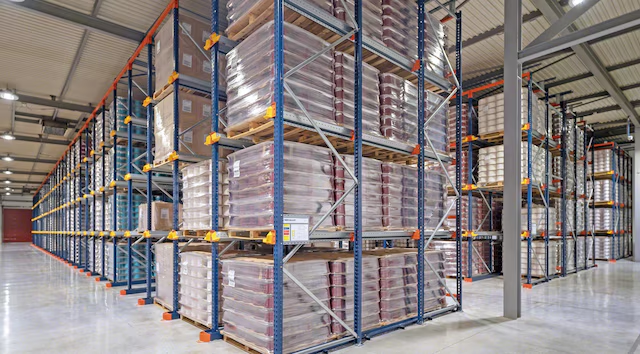
Drive-in racks and drive-through racks are ideal for high-density storage and often go from floor to ceiling. Constructed of durable steel, these warehouse racking systems offer enough space for a forklift to move into each bay. It’s important to note that drive-in racks have one entrance and exit, but drive-through racks allow access on both sides of the bay.
As a result, drive-in racks are suited to the last in, first out (LIFO) process commonly used for nonperishable products. On the other hand, a drive-through system requires a first in, first out (FIFO) process.
Cold storage facilities frequently use these racking systems to store perishable goods in high-density storage. However, they’re also popular in industries like manufacturing, where businesses need to store lots of raw materials.
Pros
- Maximizes space for bulk storage
- Reduces square footage for storing large quantities
- Efficient inventory rotation for perishable goods
Cons
- Less effective for warehouses with SKU variety
- Limited to LIFO and FIFO strategies
Push Back Racking Systems
Typically used for bulk storage, push back racking systems store products that span two to five pallets. When employees load a pallet onto the system, it pushes the next pallet back. When employees unload a pallet, it goes to the front of the rack.
Push-back racking systems utilize the LIFO system, often featuring inclined rails, sliding carts, and double lanes. This warehouse racking strategy is ideal for storing bulk items for retail. It’s also popular in warehouses that need rapid access to products.
Pros
- Optimizes space with high-density storage
- Efficient loading and unloading
- Ideal for bulk storage without strict rotation needs
Cons
- Limited capacity for rotating inventory
- More expensive because of its design and inclined rails
Flow Racks
Also known as gravity racks, flow racks are popular for high-density storage. Flow racks use gravity rollers that move with the rack load and feature brakes or speed controllers to regulate item movement.
With this type of warehouse racking system, employees load items at the higher end and remove them at the lower end with a FIFO system. Product rotation happens automatically, as the racks flow with each load. One advantage of flow racks is that they don’t require electricity because gravity powers them.
Flow racks are common in distribution centers, food and beverage industries, and warehouses where strict inventory rotation is critical. They’re ideal for high-volume, fast-moving warehouses with rapid stock turnover.
Pros
- Doesn’t require electricity
- Automatically rotates inventory
- Streamlines picking and replenishment
Cons
- Higher cost due to rollers and braking systems
- Works best with uniform product sizes and weights
- Complex installation