Shelves are core warehouse equipment that improve warehouse utilization and access efficiency with a wide range of application scenarios. Modular assembled shelves allow flexible adjustment of layer height and spacing to adapt to different cargo storage requirements. Featuring high space utilization, easy assembly and disassembly, reusable assembly and short construction cycle, they have become the mainstream shelf structure on the market.
As the core load-bearing component of modular shelves, shelf uprights directly determine the structural safety and economic efficiency of shelf systems. Assembled shelves consist of uprights, beams and auxiliary accessories including floor bases, support rods, guardrails and laminates. High-quality uprights can bear a maximum load of 21 tons. This article focuses on the core key points for the design and selection of shelf uprights.
Practices and calculations prove that the core factors determining the load capacity and stability of shelf uprights include raw material properties, mold precision and processing technology. The aperture of uprights directly affects the overall stability of shelves, while local thinning of material sections has negligible impact on stability.
Shelf uprights are mostly rolled from thin steel plates, and conventional sections are not prone to local instability. With the trend of lightweight and thin-walled design for modern uprights and the application of high-strength steel, overall instability risks are increased. Therefore, stability design is the core priority of shelf production.
Made of cold-formed thin-walled steel, shelf uprights retain residual processing stress and bear complex force conditions. Especially for high-rise shelves with multiple layers and heavy loads, extremely high standards are required for the strength and stability of uprights, demanding rigorous design and inspection specifications.
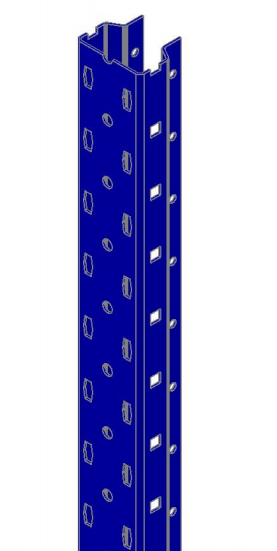
Hooks and round holes are reserved on the front of uprights for beam connection and safety pin installation. Mainstream uprights adopt octagonal, rhombic or inverted trapezoidal structures with slightly inclined long holes. After installation, beams can be self-locked by gravity, achieving tight fitting and uniform
Perforations greatly reduce the load capacity of uprights, leaving only 70% to 95% of the original structural bearing capacity, with a more prominent impact on small-sized uprights. Accordingly, on the premise of meeting assembly and usage requirements, the size and quantity of perforations should be minimized to maximize the load-bearing performance of uprights.
Flat profiles dominate the shelf upright market. Simple profiles are applied to light-duty shelves, while complex high-strength multi-roll rolled profiles are used for heavy-duty shelves. Derivative profiles with bent side reinforcements effectively enhance the stiffness and overall stability of shelf uprights.
In the refined design of shelf uprights, in addition to strength, stiffness and structural stability requirements, full consideration should be given to molding processes, rolling passes and blank pretreatment to avoid defects caused by pre-punching and bending deformation, so as to guarantee the overall quality of finished uprights.
Gezhi provides a full range of warehousing equipment including pallet shelves, cantilever shelves, electric mobile shelves, mezzanine platforms, shuttle storage systems, push-back shelves, long-span shelves, rivet shelves, drive-in shelves, carton flow racks and stackable shelves. We offer customized all-in-one storage solutions to meet the warehousing needs of various industries.