
Safe loading and unloading are among the most critical daily operations in any warehouse. They play a vital role in protecting workers, securing goods, and maintaining the long‑term stability of the entire racking system. In many cases, rack deformation, local damage, and even serious safety accidents are not caused by design or material defects. Instead, they result from long‑term improper loading, overloading, and unsafe handling habits.
For this reason, establishing clear loading standards and strictly following them in daily operations is the foundation of a safe and reliable ပယ်လက်စင်စနစ်.
Strictly Control Beam Load Capacity and Avoid Overloading
Every racking system is designed with specific structural load limits, including upright capacity, beam capacity, and overall safety margins. Among these, beam load capacity is the most direct and important operational limit.
In actual use, the designed load capacity must be strictly observed, and overloading should never be allowed. Even if the rack looks fine in the short term, continuous overloading will gradually deform beams, create abnormal stress at connections, and eventually reduce the stability of the entire structure.
At GeZhi, we determine load capacity based on your actual requirements, such as pallet weight, product density, and storage methods. We also clearly mark safe load limits during the design phase, helping you establish clear operational boundaries from the start and reduce risks at the source.
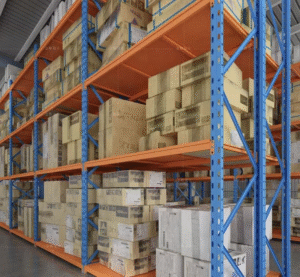
Place Pallets Correctly for Even Load Distribution
How pallets are placed on beams directly affects the stress condition of the racking system. Standard practice requires pallets to be positioned as close to the center of the beams as possible to ensure even load distribution.
Off‑center loading is a very common but often overlooked problem in warehouses. When pallets are consistently placed to one side, uneven stress occurs, increasing local loads, causing metal fatigue, and over time leading to beam twisting or deformation.
Additionally, pallets must be fully supported within the effective beam area. Any overhang or partial support should be avoided. This is especially dangerous during forklift operations, as even minor collisions can cause instability or falling goods.
Although simple, correct pallet placement significantly improves safety and extends equipment life.
Use Qualified Pallets and Inspect Them Regularly
Pallets are the direct connection between goods and the racking system, so their condition greatly affects overall safety. Yet, pallets are often neglected in daily warehouse management.
Damaged, cracked, deformed, or aged pallets cannot distribute weight properly. In extreme cases, they may break suddenly under load, causing goods to scatter and potentially triggering safety incidents.
It is therefore recommended to implement a regular pallet inspection system and eliminate any pallets that do not meet safety standards. In high‑intensity environments, a full pallet lifecycle management process should be in place to prevent unsafe pallets from being reused.
Strengthen Operator Training and Build Safe Work Habits
Even the best racking system cannot guarantee safety without proper operation. Operator training is therefore a key part of warehouse safety management.
Training should be practical and consistent, covering:
- Understanding and following the load limits of each beam level
- Developing habits for even load distribution
- Following correct forklift operating procedures and avoiding collisions
- Immediately reporting abnormalities such as deformation or loose connections
Through ongoing training and habit formation, human‑related risks can be significantly reduced, greatly improving overall warehouse safety.