
When selecting customized storage racking, we design it based on five key factors: building structure, characteristics and dimensions of stored goods, accessibility, handling equipment, and inbound/outbound volume. Here is a detailed breakdown:
1. Building Structure (Available height, column positions, floor conditions, fire protection facilities)
When choosing racking, consider the clear height under the ceiling to determine the racking height. The position of columns will affect the layout of the racking. Floor load-bearing capacity and levelness are also critical for the design and installation of the racking. In addition, fire protection and lighting facilities must be taken into account to ensure proper installation locations.
2. Characteristics and Dimensions of Stored Goods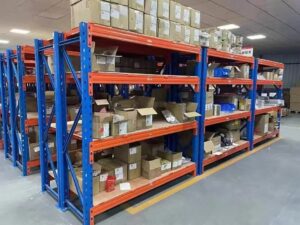
The size and shape of stored goods directly determine the specifications of the racking, while the weight of the goods affects the load-bearing capacity required. The storage unit—whether it is pallets, bins, or individual items—also dictates the type of racking needed.
To estimate the total number of storage positions, you should account for your company’s growth needs over the next 1–2 years. This data can be obtained from your inventory management system, or you can consult our professional team for recommendations before we start designing the racking.
3. Accessibility (Storage density, FIFO, inventory management)
Accessibility and storage density are generally inversely related. To achieve high storage density, you often have to sacrifice some accessibility.
While certain racking types offer excellent storage density, their inventory management is more complex, and they usually cannot support FIFO (First-In, First-Out) control. Automated storage and retrieval systems (AS/RS) provide both optimal accessibility and density but require a higher investment.
Choosing the right storage system is a trade-off of various factors and a strategic decision. For a comparison of accessibility and storage density across different racking types, please contact us for more information.
4. Handling Equipment (Reach type, upright aisle width, lifting height, lifting capacity, turning radius)
All storage operations rely on handling equipment, so your choice of racking must align with your handling devices. Forklifts are the most commonly used equipment, and the aisle width of the racking will directly determine whether you need a reach truck or a counterbalance forklift.
5. Inbound/Outbound Volume (FIFO, storage frequency, picking volume)
Some racking types offer high storage density but have low inbound/outbound efficiency, making them suitable for low-frequency operations. Inbound/outbound volume is a key metric that must be considered when selecting a racking type.